7 Key Components of a High-Converting Landing Page
A high-converting landing page is essential when creating a digital marketing campaign. It acts as a bridge between your audience and your conversion objective, whether that be generating leads, signups, or sales. A well-optimized landing page can enhance your conversion rate, boost user engagement, and decrease bounce rates.
An attractive landing page isn’t enough. If your landing page is not high-converting, then it is the wrong strategy. Every element on the page should work towards a specific action desired for visitors. According to HubSpot, a company with 10-15 landing pages records 55% more leads. This reaffirms that a landing page is essential, and it should be optimized for conversions.
Top Strategies for Creating a High-Converting Landing Page
Before diving into the key components, it’s helpful to understand the foundational strategies for building a page that performs well.
Plan Your Landing Page
You need a solid plan before designing your landing page. Know your target audience, understand their pain points, and define what you want them to do. A well-planned strategy for your landing page helps create a user journey that is smooth and ultimately converts.
Keep It Simple and Focused
When it comes to landing pages, simplicity is paramount. Avoid clutter and distractions. Focus on just one goal per landing page. This keeps the visitor centered on a single action. Studies show that reducing form fields from four to three can increase conversion rates by up to 50%.
Use the Right Tools
Using the right tools can make a significant difference. Platforms like Unbounce, Instapage, and Leadpages provide templates that you can use and A/B test to optimize your performance. Heatmap tools such as Hotjar can help study user behavior and identify areas needing improvement.
Speed and Mobile Optimization
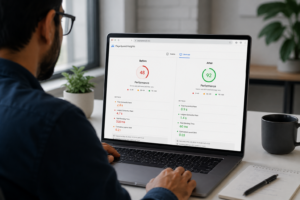
Slow loading pages lead to lost conversions. Studies by Google show that a one-second delay in page load time can impact conversion rates by 7%. Additionally, 57% of users abandon a page that takes over three seconds to load. Ensure your landing page is fast and fully responsive for mobile users.
Test and Improve
Optimization is an ongoing process. Regularly test elements on your landing page, such as headlines, CTAs, colors, and layouts. A/B testing helps you improve over time by identifying what works best for your audience.
The 7 Essential Elements of a High-Converting Landing Page
Here are the seven essential elements you need to include for a successful page.
1. Compelling Headline
Headlines are the first thing visitors see and must grab their attention immediately. A strong headline should:
- Be clear and concise
- Highlight the value proposition
- Evoke curiosity or urgency
For instance, instead of a headline like ‘Try Our Software,’ use ‘Boost Your Sales by 300% with AI-Powered Software.’
2. Clear and Concise Call to Action (CTA)
Conversions are closely tied to your CTA. It should be visually distinct and action-oriented. Rather than “Submit,” use “Get My Free Trial” or “Start Saving Today.” Ensure that the CTA button is easily visible.
3. Visually Appealing Design
Landing pages should not only be aesthetically pleasing but also functional. Use:
- A clean layout
- Contrasting colors for important elements
- Ample white space for readability
- Easy-to-read fonts
This will further increase the likelihood of conversions.
4. Social Proof and Trust Signals
People trust recommendations from others. Adding social proof can significantly increase conversions. This includes:
- Customer testimonials
- Case studies
- Reviews and ratings
- Trust badges such as SSL security or industry certifications
A BrightLocal survey discovered that 88% of consumers trust online reviews as much as personal recommendations.
5. Concise Copy and Value Proposition
Your landing page copy should be persuasive and concise. Clearly state your value proposition, emphasizing key benefits with bullet points instead of lengthy paragraphs. Most users spend no more than 15 seconds on a page deciding whether to stay or leave.
6. Lead Capture Form
To capture leads, an optimized form is essential. Eliminate unnecessary questions and keep it short. Fewer fields lead to higher conversion rates. Use progressive profiling to collect data over time instead of all at once.
7. Compelling Visuals and Media
Visual elements can enhance engagement and understanding. Use:
- High-quality images
- Explainer videos
- Infographics
- Illustrations
Research indicates that videos on landing pages can increase conversions by up to 80%. Short, engaging videos explaining your product or service can be game changers.
Top-Notch Tips to Make Your Landing Page High-Converting
Use A/B Testing to Find Optimal Solutions
Continuous testing is essential for achieving optimization. Conduct A/B tests for different elements that need examination.
- Headlines
- CTA placement
- Color schemes
- Images vs. videos
Utilizing data-driven choices leads to improved conversion rates over time.
Minimize Distractions
Eliminate navigation elements, sidebars, and unnecessary links. Users should remain focused on the conversion activity.
Use FOMO as a Strategy
Creating urgency among customers can increase conversions. Use phrases for limited-time sales and when only a few spots are left.
Optimize for SEO
To drive organic traffic, use:
- Relevant keywords in headings and content
- Fast-loading images
- Mobile-friendly design
- Meta descriptions and title tags
Leverage Personalization
Tailor content for visitors based on their behavior. Engagement can increase by using dynamic landing pages that display personalized messages depending on user demographics or past interactions.
Make Your CTA Button Stand Out
It must be highly visible. Use contrasting colors, large buttons, and persuasive text to encourage actions.
Match Your Landing Page to Your Ad Copy
If visitors came to your page through an ad, it should have the same message. Bounce rates rise when content is mismatched.
Conclusion
A high-converting landing page is an effective way of generating leads and sales. By integrating these elements, you will start creating a landing page that converts visitors into leads and leads into customers. Key components include optimization, testing, and analysis to achieve the highest performance.
Optimization is an ongoing process. Test it again, analyze, and refine your landing page to achieve the highest performance possible. Implement these strategies to see a significant uplift in your conversion rates!
Do you require help designing a landing page that will bring in conversions for your company? Contact us today and together we’ll create a page that will make a difference!